A Unicode-aware string class. More...
#include <String.h>
Public Types | |
| using | Unique = std::unique_ptr<String> |
| Unique pointer. | |
| using | Shared = std::shared_ptr<String> |
| Shared pointer. | |
| using | Option = std::optional<String> |
| Optional. | |
| using | size_type = std::string::size_type |
| Class size type. | |
| using | sizeOption = std::optional<size_type> |
| Optional size type (used to indicate an unspecified or non-existant position) | |
| using | Filter = std::function<bool(char32_t)> |
| Unary predicate for filtering strings. | |
| using | Function = std::function<std::optional<char32_t>(char32_t)> |
| Unary functions for processing string characters. | |
Public Member Functions | |
| String () | |
| String (const BufferIn &&source) | |
| String (const char *source, sizeOption howMany=std::nullopt, DataFormat format=DataFormat{}) | |
| String (const char8_t *source, sizeOption howMany=std::nullopt) | |
| String (const char16_t *source, sizeOption howMany=std::nullopt, bool isBigEndian=Memory::defaultEndian) | |
| String (const char32_t *source, sizeOption howMany=std::nullopt, bool isBigEndian=Memory::defaultEndian) | |
| String (const std::string &source, sizeOption howMany=std::nullopt, DataFormat format=DataFormat{}) | |
| String (const std::u8string &source, sizeOption howMany=std::nullopt) | |
| String (const std::u16string &source, sizeOption howMany=std::nullopt) | |
| String (const std::u32string &source, sizeOption howMany=std::nullopt) | |
| String (size_type newSize, const String &fillText) | |
| String (char val) | |
| String (int16_t val) | |
| String (uint16_t val) | |
| String (int32_t val) | |
| String (uint32_t val) | |
| String (int64_t val) | |
| String (uint64_t val) | |
| String (size_t val) | |
| String (double val, double prec=math::eps, bool padZero=false) | |
| String (const String &source) | |
| String (String &&source) noexcept | |
| ~String () | |
| operator std::string () const | |
| Conversion to std::string. | |
| operator std::u8string () const | |
| Conversion to std::u8string. | |
| operator std::u16string () const | |
| Conversion to std::u16string. | |
| operator std::u32string () const | |
| Conversion to std::u32string. | |
| operator int16_t () const | |
| Conversion to 16-bit integer. | |
| operator int32_t () const | |
| Conversion to 32-bit integer. | |
| operator uint32_t () const | |
| Conversion to 32-bit unsigned integer. | |
| operator int64_t () const | |
| Conversion to 64-bit integer. | |
| operator uint64_t () const | |
| Conversion to 64-bit unsigned integer. | |
| operator float () const | |
| Conversion to float. | |
| operator double () const | |
| Conversion to double (0 if conversion impossible) | |
| char32_t | operator[] (size_type index) const |
| String & | operator= (const String &source) |
| String & | operator= (String &&source) noexcept |
| String & | operator= (const char *source) |
| std::strong_ordering | operator<=> (const String &ref) const |
| bool | operator== (const String &ref) const |
| bool | operator!= (const String &ref) const |
| String & | operator+= (const String &source) |
| String & | operator+= (char source) |
| size_type | capacity () const |
| size_type | size () const |
| size_type | length () const |
| size_type | dataSize (sizeOption howMany=std::nullopt) const |
| bool | empty () const |
| const char * | data () const |
| std::string | string () const |
| char32_t | at (size_type index) const |
| void | forEach (const Function &func) const |
| String | substr (size_type startPos=0, sizeOption howMany=std::nullopt) const |
| String | uppercase () const |
| String | lowercase () const |
| std::optional< int16_t > | toInt16 () const |
| Conversion to optional int16_t (nullopt if conversion impossible) | |
| std::optional< int32_t > | toInt32 () const |
| Conversion to optional int32_t (nullopt if conversion impossible) | |
| std::optional< uint32_t > | toUInt32 () const |
| Conversion to optional uint32_t (nullopt if conversion impossible) | |
| std::optional< int64_t > | toInt64 () const |
| Conversion to optional int64_t (nullopt if conversion impossible) | |
| std::optional< uint64_t > | toUInt64 () const |
| Conversion to optional uint64_t (nullopt if conversion impossible) | |
| std::optional< float > | toFloat () const |
| Conversion to optional float (nullopt if conversion impossible) | |
| std::optional< double > | toDouble () const |
| Conversion to optional double (nullopt if conversion impossible) | |
| const BufferOut & | writeTo (const BufferOut &buffer, DataFormat format=UTF8, bool isNullAdded=true, sizeOption howMany=std::nullopt, sizeOption maxLen=std::nullopt) const |
| const BufferOut & | writeUTF8 (const BufferOut &buffer, bool isNullAdded=true, sizeOption howMany=std::nullopt, sizeOption maxLen=std::nullopt) const |
| const BufferOut & | writeUTF16 (const BufferOut &buffer, bool isNullAdded=true, bool isBigEndian=DataFormat::defaultEndian, sizeOption howMany=std::nullopt, sizeOption maxLen=std::nullopt) const |
| const BufferOut & | writeUTF32 (const BufferOut &buffer, bool isNullAdded=true, bool isBigEndian=DataFormat::defaultEndian, sizeOption howMany=std::nullopt, sizeOption maxLen=std::nullopt) const |
| bool | isAlphaNumeric (size_type startPos=0, sizeOption howMany=std::nullopt) const |
| bool | isAlpha (size_type startPos=0, sizeOption howMany=std::nullopt) const |
| bool | isNumeric (size_type startPos=0, sizeOption howMany=std::nullopt) const |
| std::strong_ordering | compare (const String &ref) const |
| sizeOption | find (const String &toFind, size_type startPos=0) const |
| sizeOption | findIf (const Filter &filter) const |
| bool | contains (const String &toFind) const |
| bool | startsWith (const String &toFind) const |
| bool | endsWith (const String &toFind) const |
| sizeOption | findFirstOf (const String &toFind, size_type startPos=0) const |
| sizeOption | findFirstNotOf (const String &toFind, size_type startPos=0) const |
| sizeOption | findLastOf (const String &toFind, sizeOption lastPos=std::nullopt) const |
| sizeOption | findLastNotOf (const String &toFind, sizeOption lastPos=std::nullopt) const |
| sizeOption | rfind (const String &toFind, sizeOption lastPos=std::nullopt) const |
| void | reserve (size_type newSize) |
| void | resize (size_type newSize, const String &padding="") |
| void | clear () |
| void | forEach (const Function &func) |
| String & | assign (const String &source) |
| size_type | assign (const char *source, sizeOption byteCount=std::nullopt, sizeOption charCount=std::nullopt, DataFormat format=DataFormat{}) |
| String & | append (const String &source) |
| String & | append (char source) |
| String & | append (char32_t source) |
| String & | insert (size_type pos, const String &source, size_type start=0, sizeOption howMany=std::nullopt) |
| String & | replace (sizeOption pos, sizeOption num, const String &source, size_type start=0, sizeOption howMany=std::nullopt) |
| String & | replaceAll (const String &toFind, const String &replacement=String()) |
| String & | replaceIf (const Filter &filter, const String &replacement=String()) |
| String & | replaceAnyOf (const String &charsToFind, const String &replacement=String()) |
| String & | erase (size_type pos=0, sizeOption howMany=std::nullopt) |
| void | popBack () |
| String & | padRight (size_type length, const String &repeat=" ") |
| String & | padLeft (size_type length, const String &repeat=" ") |
Static Public Member Functions | |
| static size_type | getValidByteCount (const char *text, sizeOption howMany=std::nullopt, sizeOption charCount=std::nullopt, DataFormat format=DataFormat{}) |
| static sizeOption | getCharacterByteCount (const char *text, sizeOption howMany=std::nullopt, DataFormat format=DataFormat{}) |
| static String::sizeOption | getCharacterCount (const char *text, sizeOption howMany=std::nullopt, DataFormat format=DataFormat{}) |
| static std::pair< char32_t, size_type > | getUnicodeChar (const char *text, sizeOption howMany=std::nullopt, DataFormat format=DataFormat{}) |
| static std::optional< std::u32string > | toUnicode (const char *&text, String::sizeOption howMany=std::nullopt, bool isCountRequired=false) |
| static std::optional< String > | fromUnicode (const char32_t *&text, bool isBigEndian, String::sizeOption howMany=std::nullopt, bool isCountRequired=false) |
| static std::optional< std::u32string > | fromUTF16 (const char16_t *&text, bool isBigEndian, String::sizeOption howMany=std::nullopt, bool isCountRequired=false) |
| static std::optional< std::u16string > | toUTF16 (const char32_t *&text, String::sizeOption howMany=std::nullopt, bool isCountRequired=false) |
Static Public Attributes | |
| static constexpr size_type | npos = std::string::npos |
| Constant to indicate an unspecified or non-existant position in std::string - use std::nullopt in this class. | |
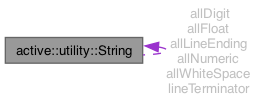
| static const String | lineTerminator {"\n"} |
| The line terminating char(s) for the current platform. | |
| static const String | allWhiteSpace {" \t\r\n"} |
| All white space characters. | |
| static const String | allLineEnding {"\r\n"} |
| All line ending characters. | |
| static const String | allDigit {"0123456789"} |
| All digit characters (0-9) | |
| static const String | allNumeric {"0123456789-"} |
| All numeric characters (integer and signed) | |
| static const String | allFloat {"0123456789.-"} |
| All floating point characters (floating and integer) | |
Detailed Description
A Unicode-aware string class.
The String class is a wrapper for std::string and leans heavily on existing functionality it provides, extending it with awareness of Unicode encodings for character positioning. This also provides easy access to the underlying std::string for easy interoperability with any code working with that type.
String content is internally encoded/validated as UTF-8, but it can be encode/decode UTF8, UTF16, UTF32, ASCII and ISO8859. Character positions are calculated to allow indexing, but the time to find a position averages O(n) It is recommended to use classes like BufferIn to analyse by-character content on large blocks of text efficiently
This class does not use a 'special' value to denote non-existent or unspecified positions, e.g. like string::npos Rather, an optional is used for these cases, e.g. if searching for a dot outside the first 5 characters of some text, using std::string could look like this:
if (auto pos = text.find("."); (pos != nos) && (pos > 4))
With this string class, the optional response simplifies the syntax:
if (auto pos = text.find("."); pos > 4)
The String class also provides a range of static functions for validating or converting blocks of text for all supported encoding. Conversion operators and constructors provide interoperability with a range of common types, e.g. std::string, std::u32string etc
In line with current C++ standards, any ranges passed by a pointer and length must be valid, e.g. the atart address must not be nullptr, or behaviour will be undefined
Constructor & Destructor Documentation
◆ String() [1/22]
|
inline |
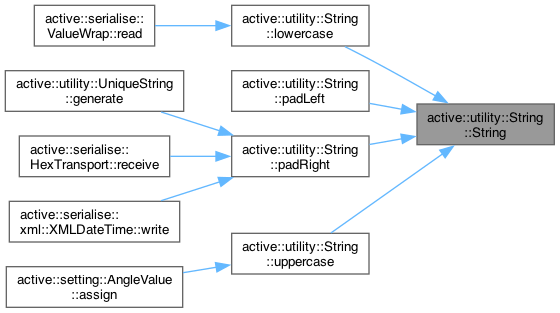
Default constructor
◆ String() [2/22]
| String::String | ( | const BufferIn && | source | ) |
Constructor from an input buffer
- Parameters
-
source The source input buffer
◆ String() [3/22]
| String::String | ( | const char * | source, |
| sizeOption | howMany = std::nullopt, | ||
| DataFormat | format = DataFormat{} ) |
Constructor from an input char array
- Parameters
-
source The character array to be copied howMany The number of bytes to copy (nullopt for full length) format The source text data format
◆ String() [4/22]
|
inline |
Constructor from an input UTF8 char array
- Parameters
-
source The character array to be copied howMany The number of bytes to copy (nullopt for full length)
◆ String() [5/22]
|
inline |
Constructor from an input UTF16 char array
- Parameters
-
source The character array to be copied howMany The number of 16-bit chars to copy (nullopt for null-terminated)
◆ String() [6/22]
|
inline |
Constructor from an input UTF32 char array
- Parameters
-
source The character array to be copied howMany The number of 32-bit chars to copy (nullopt for null-terminated)
◆ String() [7/22]
|
inline |
Constructor from an input string
- Parameters
-
source The string to be copied howMany The number of chars to copy (nullopt for full length) format The source text data format
◆ String() [8/22]
|
inline |
Constructor from an input string
- Parameters
-
source The UTF-8 string to be copied howMany The number of chars to copy (nullopt for full length)
◆ String() [9/22]
| String::String | ( | const std::u16string & | source, |
| sizeOption | howMany = std::nullopt ) |
Constructor from an input string
- Parameters
-
source The UTF-16 string to be copied howMany The number of chars to copy (nullopt for full length)
◆ String() [10/22]
| String::String | ( | const std::u32string & | source, |
| sizeOption | howMany = std::nullopt ) |
Constructor from an input string
- Parameters
-
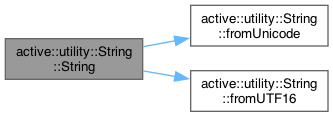
source The UTF-32 string to be copied howMany The number of chars to copy (nullopt for full length)

◆ String() [11/22]
Constructor with optional text fill expression and number of repeats
- Parameters
-
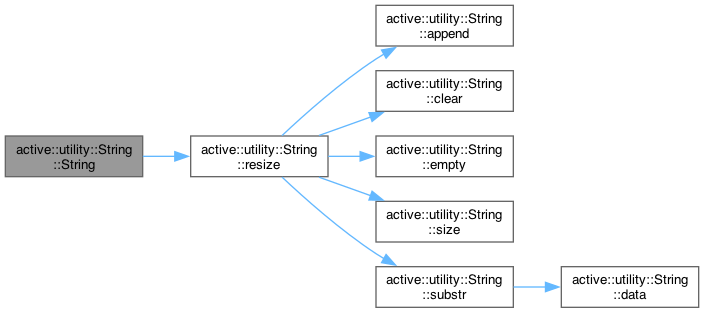
newSize The required number of expression repeats fillText The expression to fill the string
◆ String() [12/22]
|
inlineexplicit |
Constructor from a char
- Parameters
-
val A char
◆ String() [13/22]
|
inlineexplicit |
Constructor from 16-bit integer
- Parameters
-
val A 16-bit integer
◆ String() [14/22]
|
inlineexplicit |
Constructor from unsigned 16-bit integer
- Parameters
-
val An unsigned 16-bit integer
◆ String() [15/22]
|
inlineexplicit |
Constructor from 32-bit integer
- Parameters
-
val A 32-bit integer
◆ String() [16/22]
|
inlineexplicit |
Constructor from unsigned 32-bit integer
- Parameters
-
val An unsigned 32-bit integer
◆ String() [17/22]
|
inlineexplicit |
Constructor from 64-bit integer
- Parameters
-
val A 64-bit integer
◆ String() [18/22]
|
inlineexplicit |
Constructor from unsigned 64-bit integer
- Parameters
-
val An unsigned 64-bit integer
◆ String() [19/22]
|
inlineexplicit |
Constructor from size_t integer
- Parameters
-
val A size_t integer
◆ String() [20/22]
|
explicit |
Constructor from double
- Parameters
-
val A double value prec The required precision padZero True to pad the number to the specified precision with zeros

◆ String() [21/22]
| String::String | ( | const String & | source | ) |
Copy constructor
- Parameters
-
source The string to copy
◆ String() [22/22]
|
noexcept |
Move constructor
- Parameters
-
source The object to move
◆ ~String()
|
inline |
Destructor
Member Function Documentation
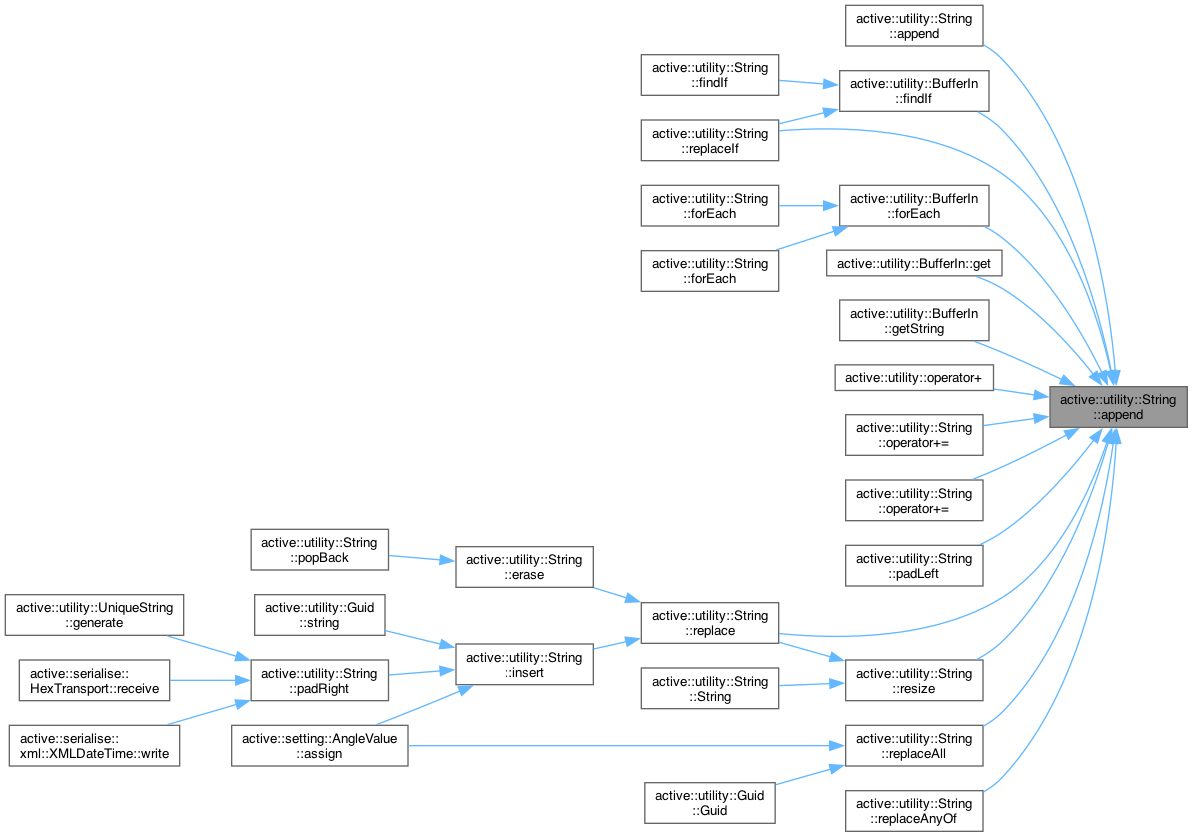
◆ append() [1/3]
|
inline |
Append the specified char to this (NB: don't use this casually - encoding must be assumed and converted accordingly)
- Parameters
-
source The char to append
- Returns
- A reference to this

◆ append() [2/3]
|
inline |
Append the specified unicode char to this
- Parameters
-
source The char to append (assumed to be UTF-32)
- Returns
- A reference to this

◆ append() [3/3]
Append the specified string to this
- Parameters
-
source The string to append
- Returns
- A reference to this
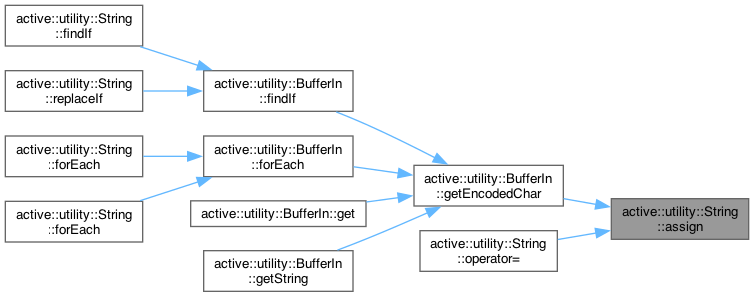
◆ assign() [1/2]
| String::size_type String::assign | ( | const char * | source, |
| sizeOption | byteCount = std::nullopt, | ||
| sizeOption | charCount = std::nullopt, | ||
| DataFormat | format = DataFormat{} ) |
Assign a specified string to this
- Parameters
-
source The character array to be copied byteCount The maximum number of bytes in the array (nullopt = null-terminated) charCount The maximum number of (encoded) characters to read (nullopt = as byteCount limit) format The source text data format
- Returns
- The number of bytes assigned from the source
◆ assign() [2/2]
Assign a specified string to this
- Parameters
-
source The string to assign
- Returns
- A reference to this
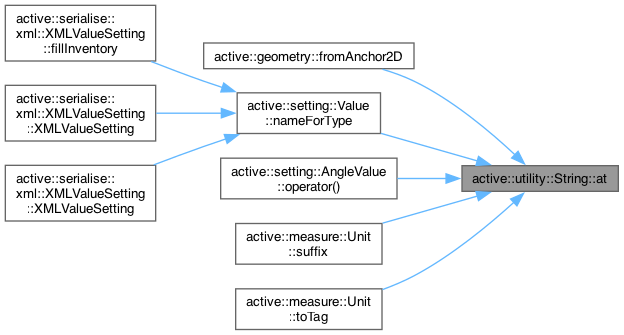
◆ at()
| char32_t String::at | ( | size_type | index | ) | const |
Subscript function
- Parameters
-
index The required character position (checked - exception thrown if out of bounds)
- Returns
- The character at the specified index

◆ capacity()
| String::size_type String::capacity | ( | ) | const |
Return the number of bytes this string can contain
- Returns
- The number of bytes this string can contain
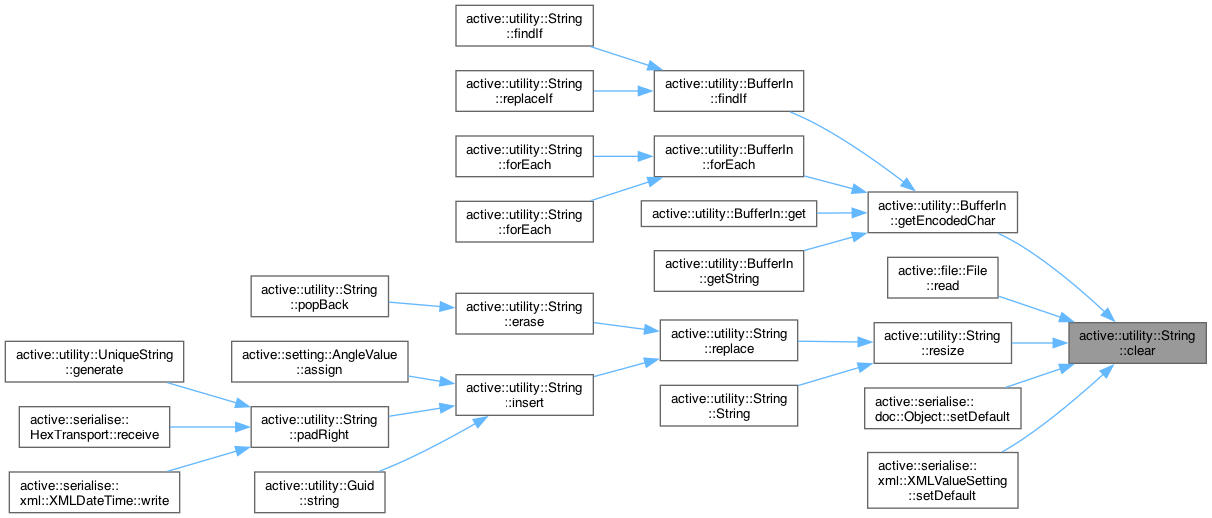
◆ clear()
|
inline |
Clear the string contents
◆ compare()
| std::strong_ordering String::compare | ( | const String & | ref | ) | const |
Three-way comparison to a reference string
- Parameters
-
ref The string to compare this to
- Returns
- The relationship between this and ref (less, equal, greater)

◆ contains()
|
inline |
Determine if the string contains a substring
- Parameters
-
toFind The substring to find
- Returns
- True if the substring is found


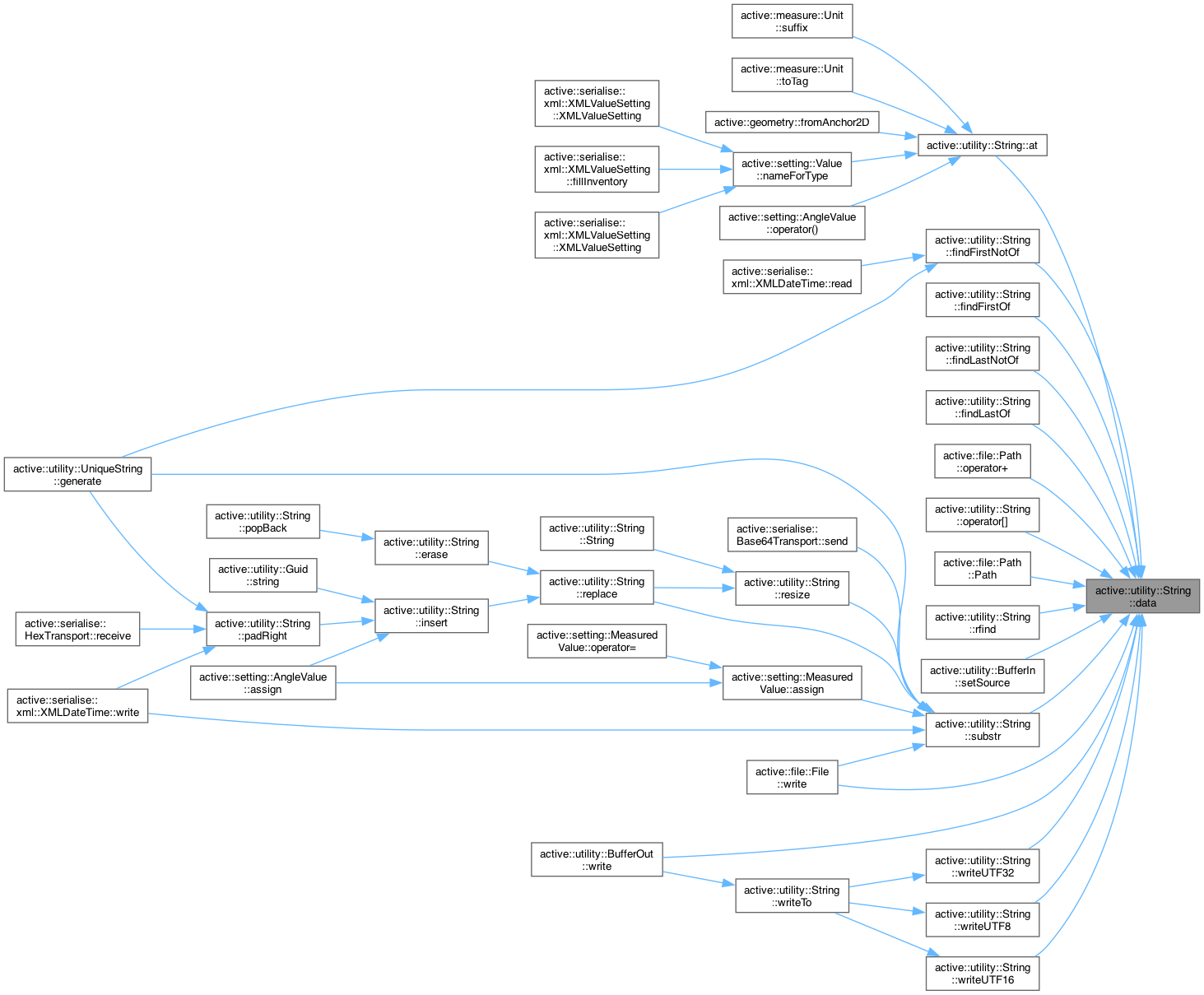
◆ data()
|
inline |
Return a pointer to a C representation of the string data
- Returns
- A pointer to the string data
◆ dataSize()
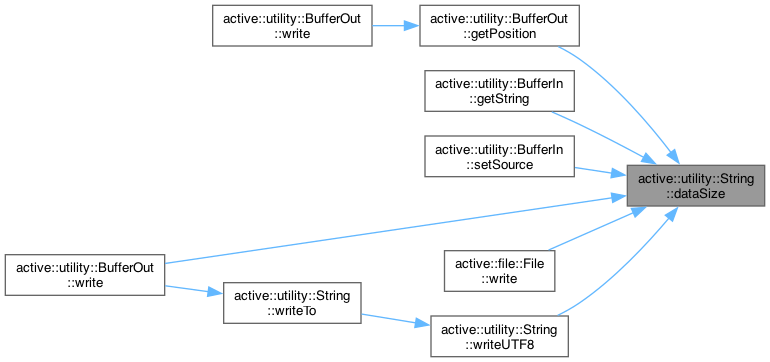
| String::size_type String::dataSize | ( | sizeOption | howMany = std::nullopt | ) | const |
Return the number of bytes consumed by this string
- Parameters
-
howMany The number of chars to count (nullopt = for full length)
- Returns
- The number of bytes consumed by the string (NB: String are null terminated, but this is not included in the data length)
◆ empty()
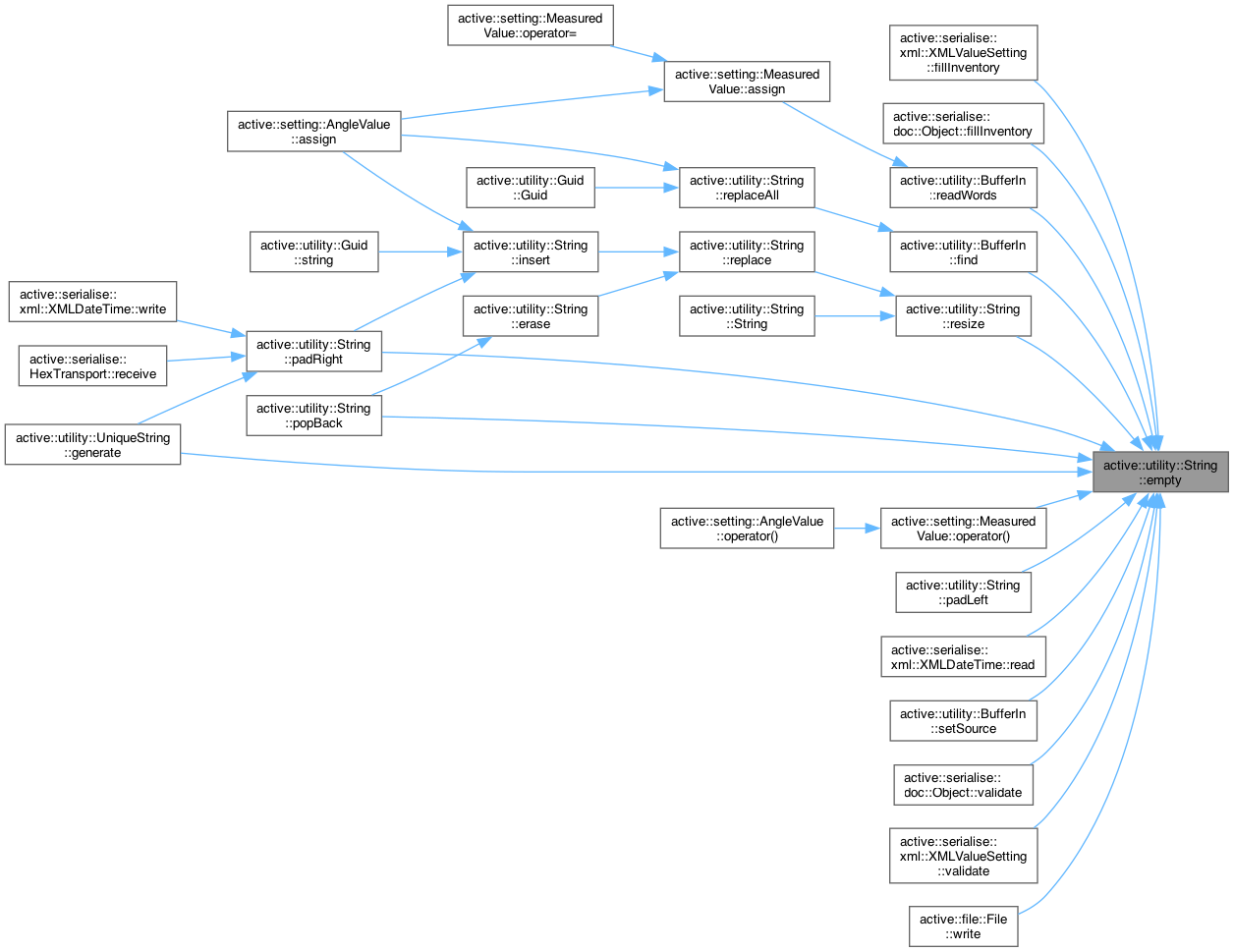
|
inline |
Determine if the string is empty
- Returns
- True is the string is empty
◆ endsWith()
|
inline |
Determine if this string ends with a substring
- Parameters
-
toFind The substring to find
- Returns
- True if this string ends with the substring
◆ erase()
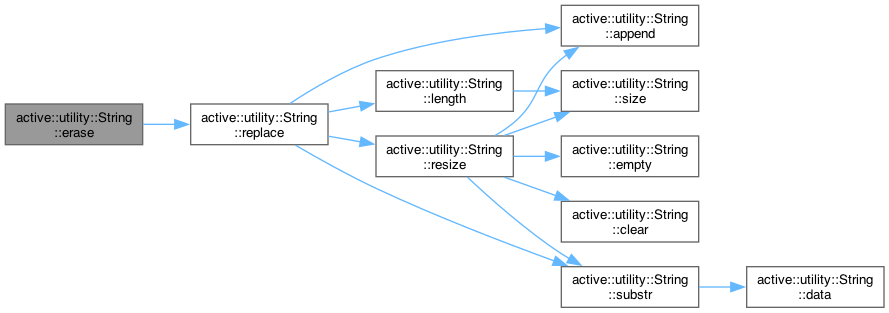
| String & String::erase | ( | size_type | pos = 0, |
| sizeOption | howMany = std::nullopt ) |
Erase a specified range of characters from a string
- Parameters
-
pos The position to erasing from howMany The number of characters to erase (nullopt to erase to end)
- Returns
- A reference to this

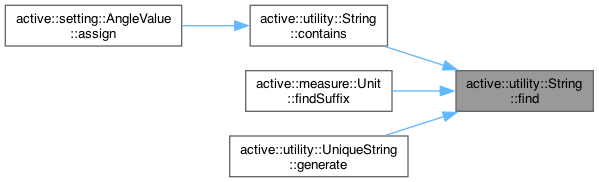
◆ find()
| String::sizeOption String::find | ( | const String & | toFind, |
| size_type | startPos = 0 ) const |
Find the specified string within this
- Parameters
-
toFind The string to find startPos The character to start searching from
- Returns
- The index where a match is found (nullopt = not found)

◆ findFirstNotOf()
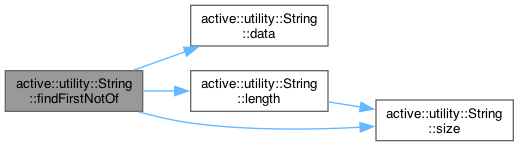
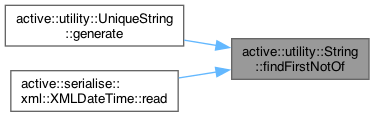
| String::sizeOption String::findFirstNotOf | ( | const String & | toFind, |
| size_type | startPos = 0 ) const |
Find the first character not in a specified string
- Parameters
-
toFind A string of characters to not find startPos The character to begin searching from
- Returns
- The index of the first non-matching character (nullopt = not found)
◆ findFirstOf()
| String::sizeOption String::findFirstOf | ( | const String & | toFind, |
| size_type | startPos = 0 ) const |
Find the first character which is in a specified string
- Parameters
-
toFind A string of characters to find startPos The character to begin searching from
- Returns
- The index of the first matching character (nullopt = not found)

◆ findIf()
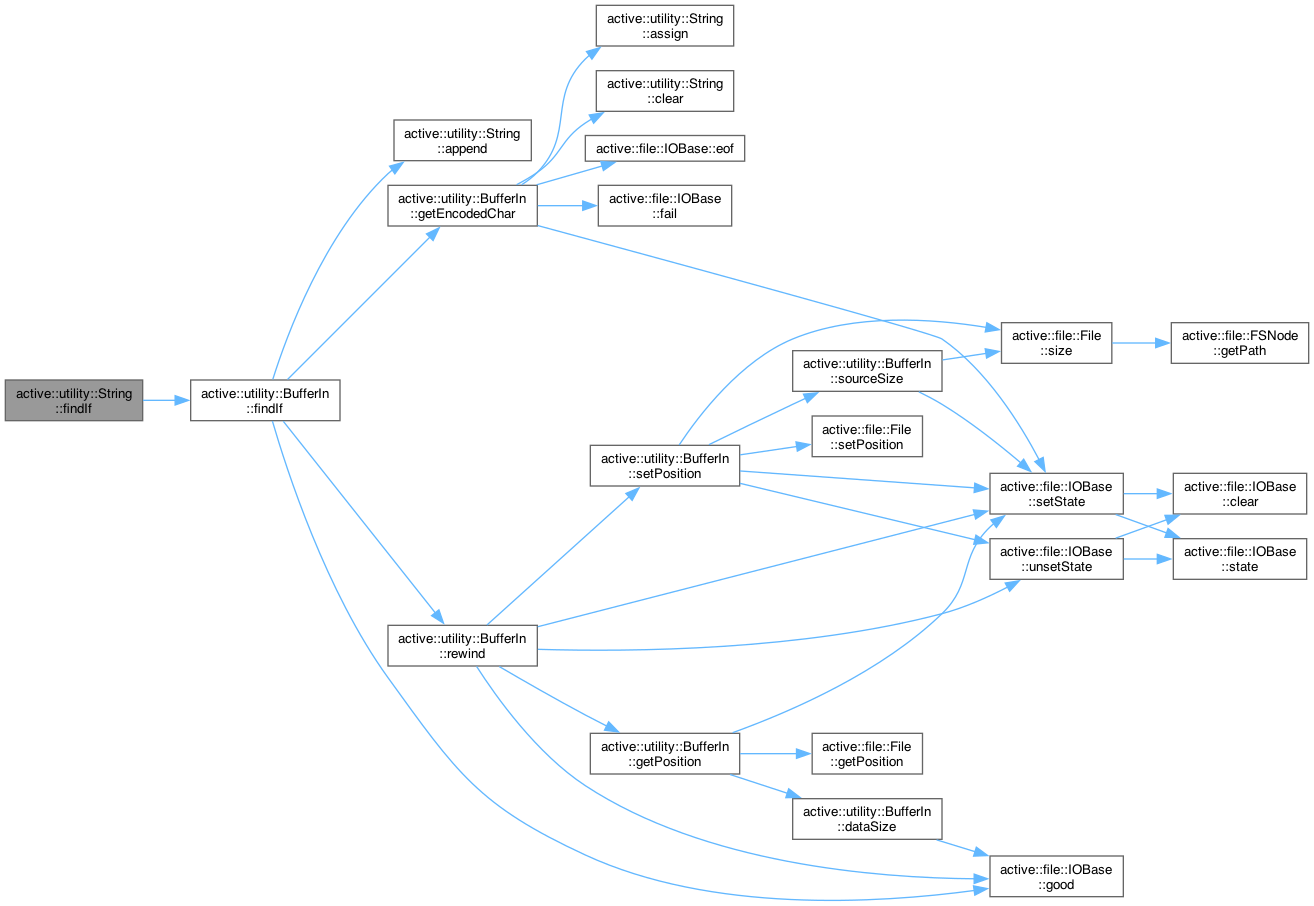
| String::sizeOption String::findIf | ( | const Filter & | filter | ) | const |
Find the specified string within this using a filter
- Parameters
-
filter The string filter
- Returns
- The index where a match is found (nullopt = not found)
◆ findLastNotOf()
| String::sizeOption String::findLastNotOf | ( | const String & | toFind, |
| sizeOption | lastPos = std::nullopt ) const |
Find the last character in this string which is not in the specified string
- Parameters
-
toFind A string of characters not to find lastPos The position of the last character to be compared
- Returns
- The index of the last non-matching character (nullopt = not found)

◆ findLastOf()
| String::sizeOption String::findLastOf | ( | const String & | toFind, |
| sizeOption | lastPos = std::nullopt ) const |
Find the last character in this string which is in the specified string
- Parameters
-
toFind A string of characters to find lastPos The position of the last character to be compared
- Returns
- The index of the last matching character (nullopt = not found)

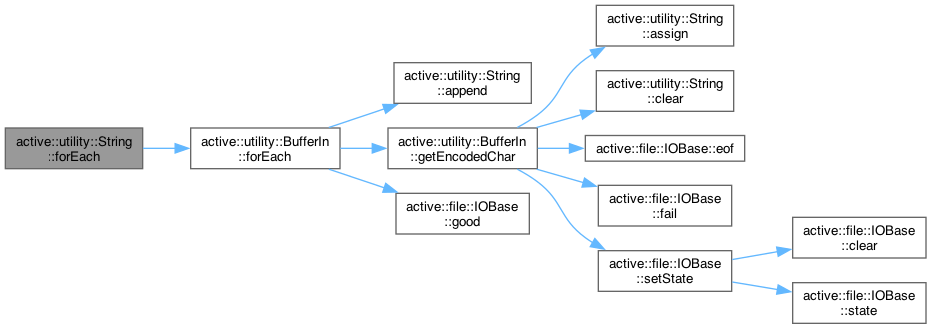
◆ forEach() [1/2]
| void String::forEach | ( | const Function & | func | ) |
Apply a function to specified characters in the string
- Parameters
-
func The character function (the returned value replaces the input character)
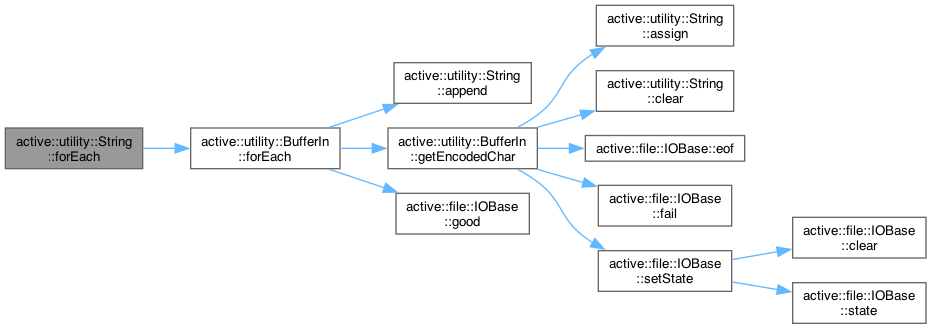
◆ forEach() [2/2]
| void String::forEach | ( | const Function & | func | ) | const |
Apply a function to specified characters in the string
- Parameters
-
func The character function (the returned value is ignored)
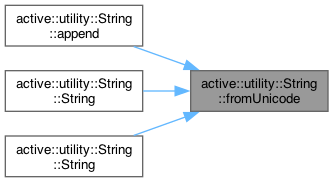
◆ fromUnicode()
|
static |
Get a UTF-8 string from a UTF-32 source
- Parameters
-
text The source text isBigEndian True if byte ordering is big-endian howMany The number of 32-bit code points in the text (nullopt = null-terminated) isCountRequired True if the specified number of code points must be valid (ignored if howMany = nullopt)
- Returns
- The UTF-8 string read from the UTF-32 source (nullopt on error, including failure to meet isCountRequired condition)
◆ fromUTF16()
|
static |
Get a UTF-32 string from a UTF-16 (16-bit) source
- Parameters
-
text The source text isBigEndian True if byte ordering is big-endian howMany The number of words (16-bit values) in the text (nullopt = null-terminated) isCountRequired True if the specified number of words must be valid (ignored if howMany = nullopt)
- Returns
- The UTF-32 string read from the UTF-16 source (nullopt on error, including failure to meet isCountRequired condition)

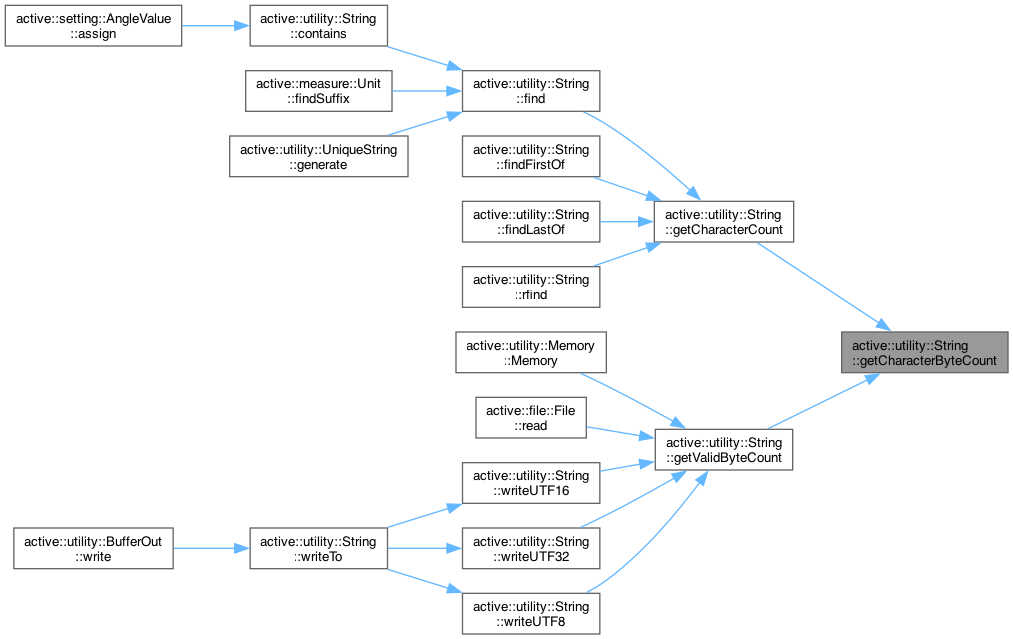
◆ getCharacterByteCount()
|
static |
Get the width of a specified character in bytes
- Parameters
-
text The source text howMany The number of bytes in the array format The text data format
- Returns
- The character width in bytes (nullopt for bad encoding)

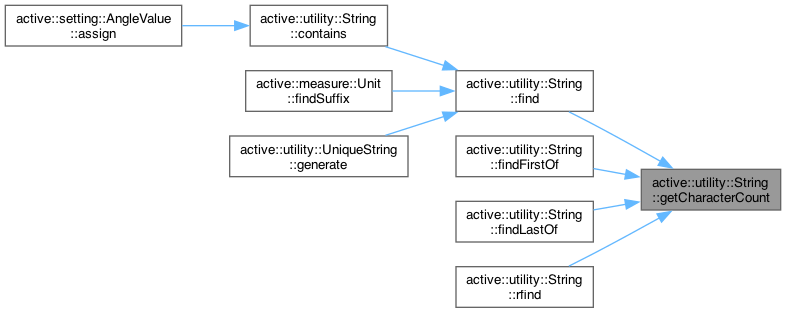
◆ getCharacterCount()
|
static |
Get the number of valid characters found at a specified address
- Parameters
-
text The source text format The text data format howMany The number of bytes in the array (nullopt = null-terminated)
- Returns
- The nummber of characters found (nullopt if bad encoding found)

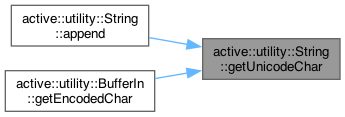
◆ getUnicodeChar()
|
static |
Get a unicode (UTF-32) character from a specified source
- Parameters
-
text The source text howMany The number of bytes in the text format The source data format
- Returns
- The unicode char paired with the number of bytes consumed from the source (0 = no valid char found)

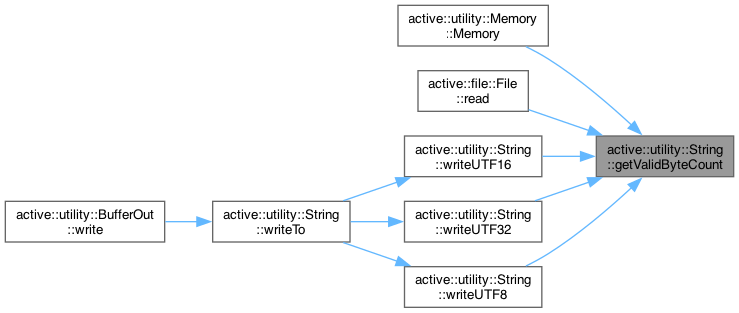
◆ getValidByteCount()
|
static |
Get the number of bytes in the specified text (counting only valid UTF8 characters)
- Parameters
-
text The source text howMany The number of bytes in the text charCount The maximum number of (encoded) chars to seek format The text data format
- Returns
- The number of bytes in the text containing valid UTF8 characters

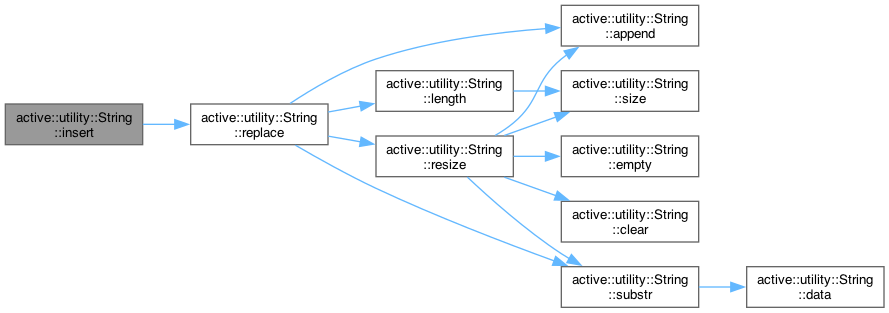
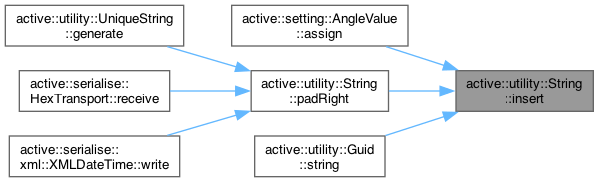
◆ insert()
| String & String::insert | ( | size_type | pos, |
| const String & | source, | ||
| size_type | start = 0, | ||
| sizeOption | howMany = std::nullopt ) |
Insert a string into this
- Parameters
-
pos The insertion point source The string to insert start The start point in the source string howMany The number of chars to insert (nullopt inserts all)
- Returns
- A reference to this
◆ isAlpha()
| bool String::isAlpha | ( | size_type | startPos = 0, |
| sizeOption | howMany = std::nullopt ) const |
Determine if the string is entirely letters
- Parameters
-
startPos The position to checking from howMany The number of characters to check (nullopt = to end)
- Returns
- True is the string is letters
◆ isAlphaNumeric()
| bool String::isAlphaNumeric | ( | size_type | startPos = 0, |
| sizeOption | howMany = std::nullopt ) const |
Determine if the string is entirely alphanumeric
- Parameters
-
startPos The position to checking from howMany The number of characters to check (nullopt = to end)
- Returns
- True is the string is alphanumeric
◆ isNumeric()
| bool String::isNumeric | ( | size_type | startPos = 0, |
| sizeOption | howMany = std::nullopt ) const |
Determine if the string is entirely numeric
- Parameters
-
startPos The position to checking from howMany The number of characters to check (nullopt = to end)
- Returns
- True is the string is numbers
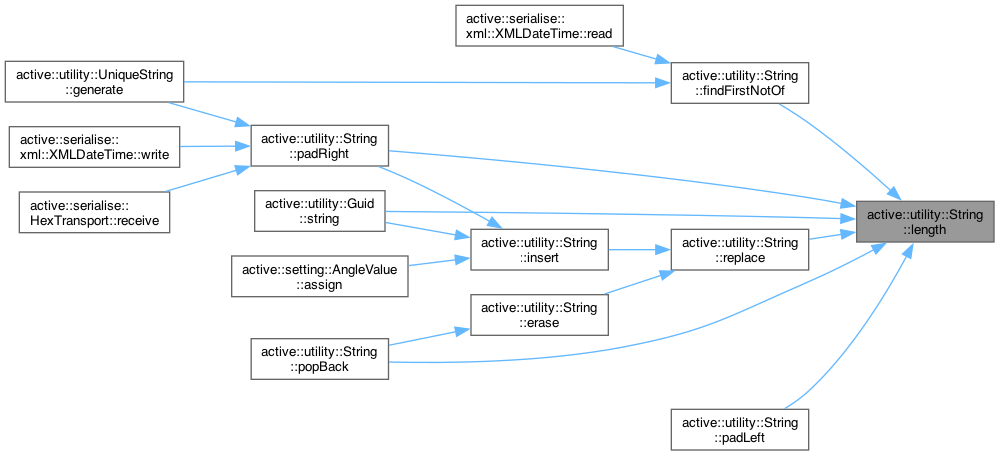
◆ length()
|
inline |
Get the string length (alias for size)
- Returns
- The number of characters in the string (size)

◆ lowercase()
| String String::lowercase | ( | ) | const |
Create a lowercase version of the string
- Returns
- A lowercase version of the string


◆ operator!=()
|
inline |
Inequality operator
- Parameters
-
ref The string to compare this to
- Returns
- True if the strings differ
◆ operator+=() [1/2]
|
inline |
Addition with assignment operator
- Parameters
-
source The char to append
- Returns
- A reference to this

◆ operator+=() [2/2]
Addition with assignment operator
- Parameters
-
source The string to append
- Returns
- A reference to this

◆ operator<=>()
|
inline |
Three-way comparison operator
- Parameters
-
ref The string to compare this to
- Returns
- The relationship between this and ref (less, equal, greater)

◆ operator=() [1/3]
| String & String::operator= | ( | const char * | source | ) |
Assignment operator
- Parameters
-
source A pointer to a char array
- Returns
- A reference to this
◆ operator=() [2/3]
Assignment operator
- Parameters
-
source The object to copy
- Returns
- A reference to this

◆ operator=() [3/3]
Move assignment operator
- Parameters
-
source The object to move
- Returns
- A reference to this
◆ operator==()
|
inline |
Equality operator
- Parameters
-
ref The string to compare this to
- Returns
- True if the strings are identical
◆ operator[]()
| char32_t String::operator[] | ( | size_type | index | ) | const |
Subscript operator
- Parameters
-
index The required character position (unchecked - out of bounds behaviour undefined)
- Returns
- The character at the specified index

◆ padLeft()
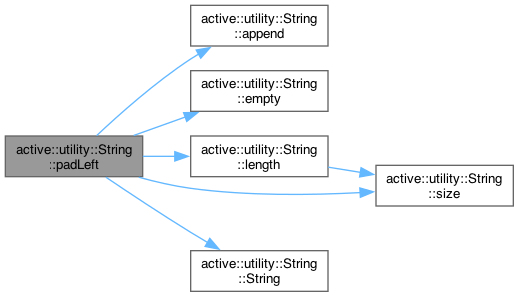
Pad the string with a repeated character to reach a specified length (so the existing content is flush with the left)
- Parameters
-
length The required string length repeat The character to repeatedly append util the length is met
- Returns
- A reference to this
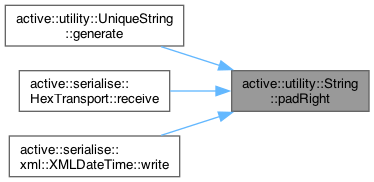
◆ padRight()
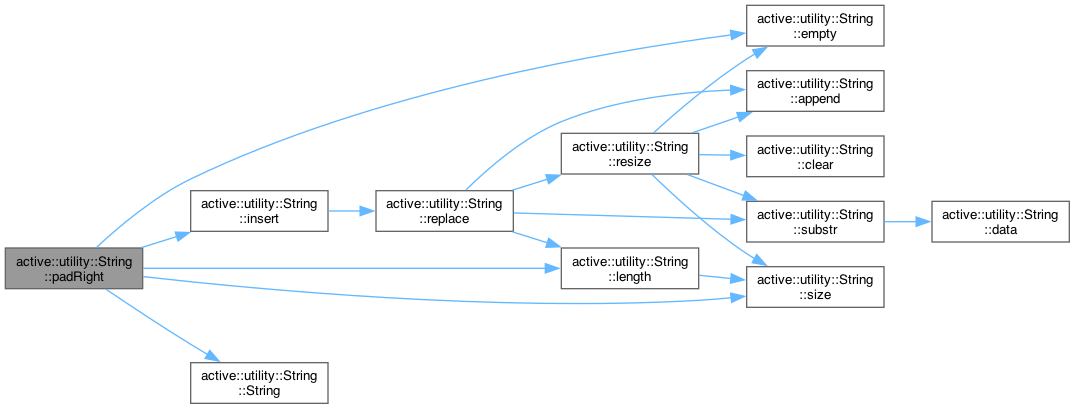
Pad the string with a repeated character to reach a specified length (so the existing content is flush with the right)
- Parameters
-
length The required string length repeat The character to repeatedly insert util the length is met
- Returns
- A reference to this
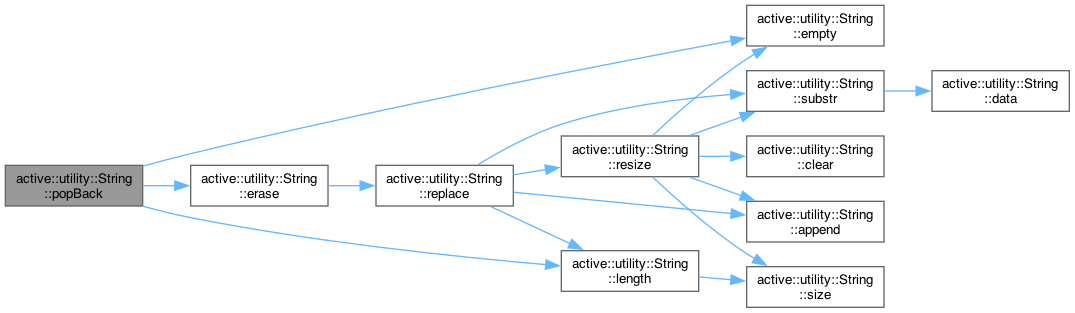
◆ popBack()
| void String::popBack | ( | ) |
Remove the last character from the string
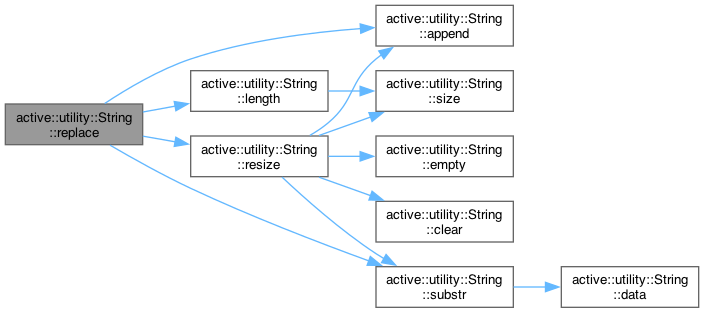
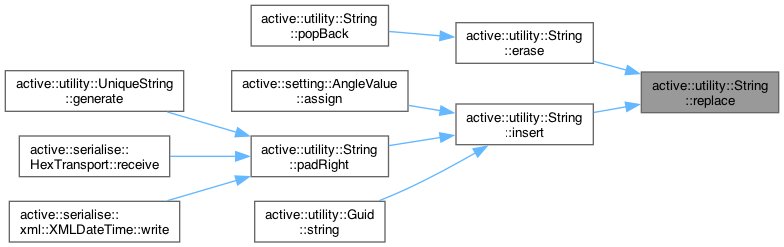
◆ replace()
| String & String::replace | ( | sizeOption | pos, |
| sizeOption | num, | ||
| const String & | source, | ||
| size_type | start = 0, | ||
| sizeOption | howMany = std::nullopt ) |
Replace a specified string segment with another string
- Parameters
-
pos The position to begin replacing (nullopt = append to end) num The number of chars to replace (nullopt = to the string end) source The replacement string start The start point in the replacement string howMany The number of chars to extract from the replacement string (nullopt inserts all)
- Returns
- A reference to this
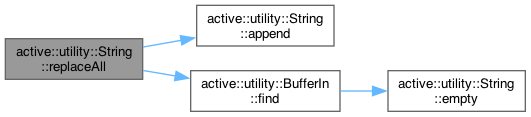
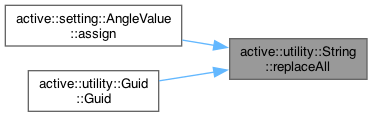
◆ replaceAll()
Replace all instances of a specified expression
- Parameters
-
toFind The expression to be replaced replacement The replacement expression
- Returns
- A reference to this
◆ replaceAnyOf()
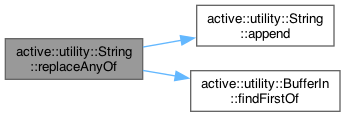
Replace any instances of specified characters
- Parameters
-
charsToFind The characters to be replaced (NB: each character is treated independently - the order does not matter) replacement The replacement expression
- Returns
- A reference to this
◆ replaceIf()
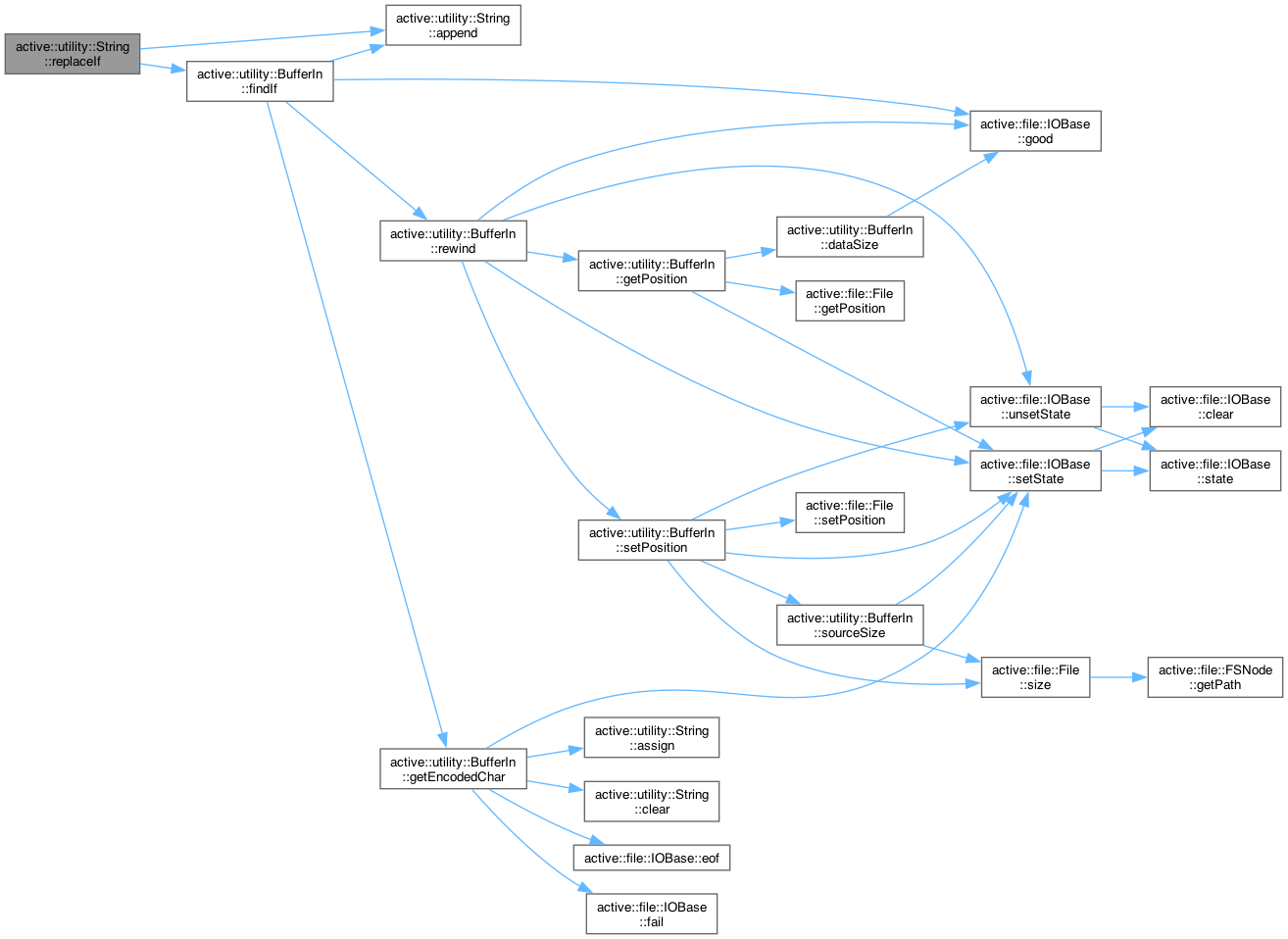
Replace all chars passing a specified filter
- Parameters
-
filter The filter for chars to be replaced replacement The replacement expression
- Returns
- A reference to this
◆ reserve()
| void String::reserve | ( | size_type | newSize | ) |
Reserve the specified number of bytes for the string to grow into
- Parameters
-
newSize The number of bytes to reserve

◆ resize()
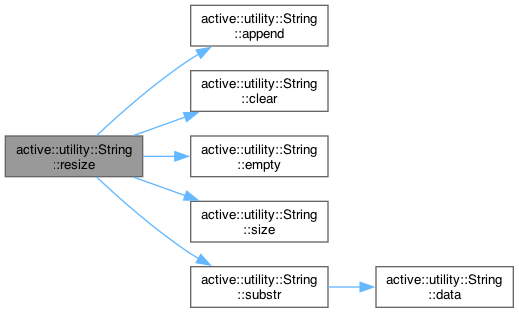
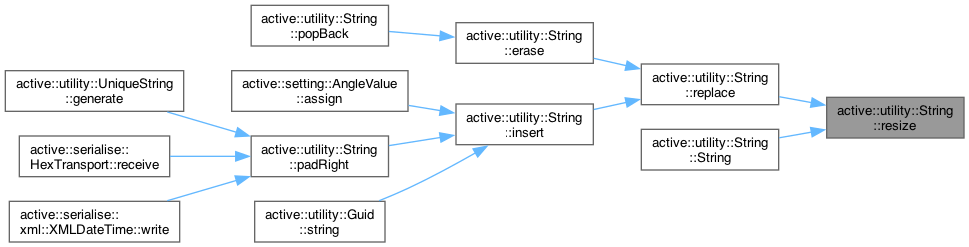
Resize the string and (when grown) pad with the specified character
- Parameters
-
newSize The required number of characters padding A padding character (when the sring grows - only the first character is used)
◆ rfind()
| String::sizeOption String::rfind | ( | const String & | toFind, |
| sizeOption | lastPos = std::nullopt ) const |
Find the specified string searching backwards
- Parameters
-
toFind The string to find lastPos The position of the last character to be compared
- Returns
- The index of a matching string (nullopt = not found)

◆ size()
| String::size_type String::size | ( | ) | const |
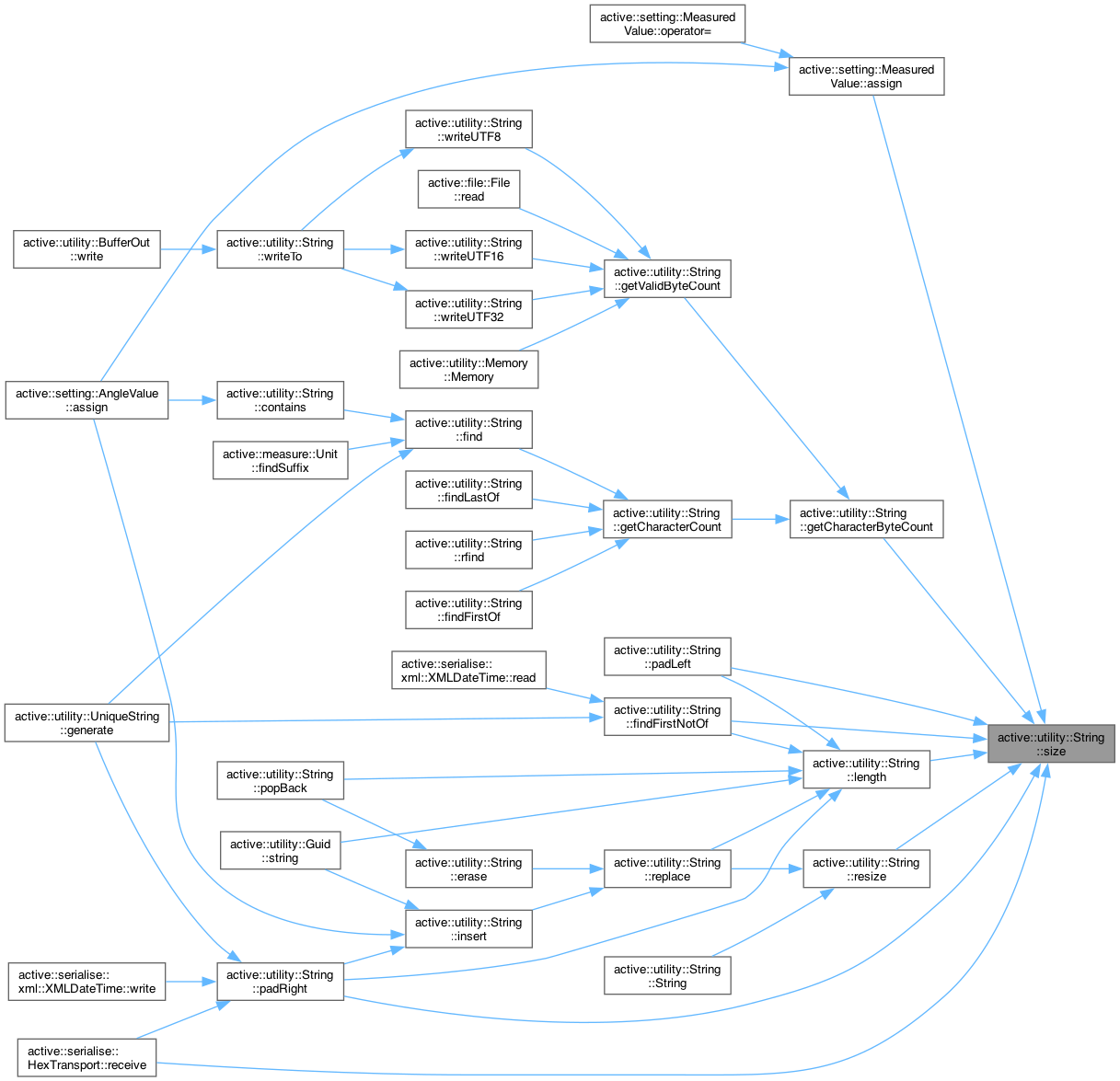
Get the number of characters in the string
- Returns
- The number of characters in the string
◆ startsWith()
|
inline |
Determine if this string starts with a substring
- Parameters
-
toFind The substring to find
- Returns
- True if this string starts with the substring
◆ string()
|
inline |
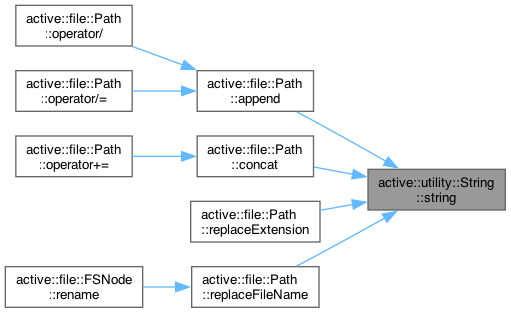
Return the string content as a std::string
- Returns
- A std::string representation
◆ substr()
| String String::substr | ( | size_type | startPos = 0, |
| sizeOption | howMany = std::nullopt ) const |
Get a specified substring of this string
- Parameters
-
startPos The position of the first character howMany The number of characters to get (nullopt for full length)
- Returns
- The requested string segment

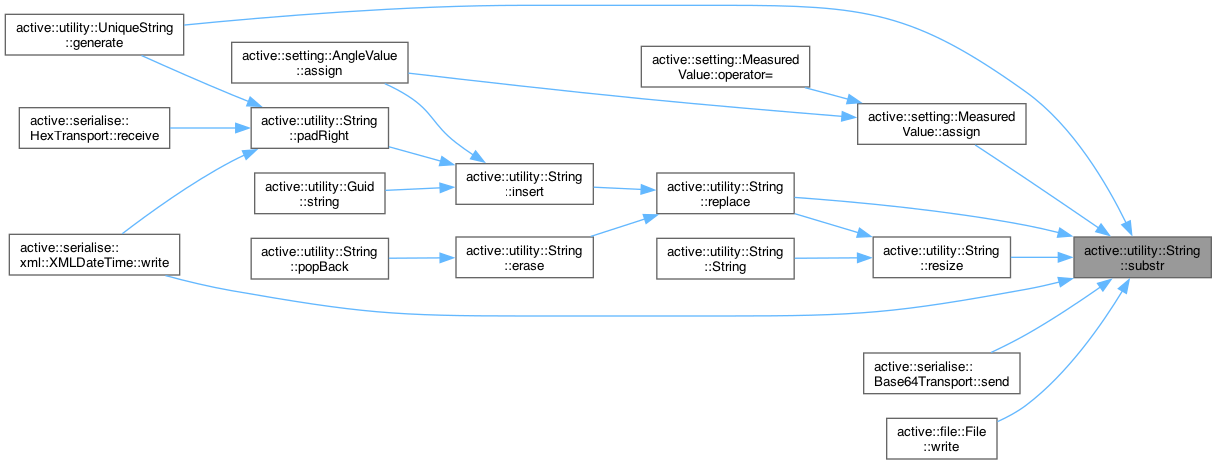
◆ toUnicode()
|
static |
Get a UTF-32 string from a UTF-8 source
- Parameters
-
text The source UTF-8 text (advances to the byte beyond the last counted character) howMany The number of bytes in the text (nullopt = null-terminated) isCountRequired True if the specified number of bytes must be valid (ignored if howMany = nullopt)
- Returns
- The unicode code point for the specified chars (nullopt on failure)
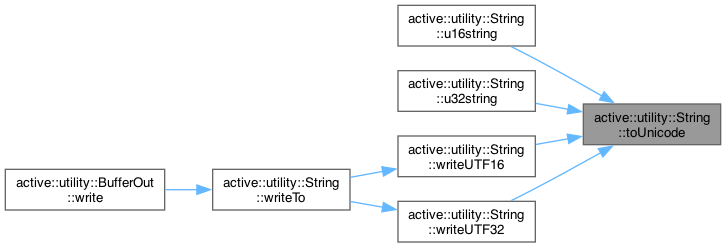
◆ toUTF16()
|
static |
Get a UTF-16 string from a UTF-32 source
- Parameters
-
text The source text howMany The number of code points in the text (nullopt = null-terminated) isCountRequired True if the specified number of code points must be valid (ignored if howMany = nullopt)
- Returns
- The UTF-16 string read from the UTF-32 source (nullopt on error, including failure to meet isCountRequired condition)

◆ uppercase()
| String String::uppercase | ( | ) | const |
Create an uppercase version of the string
- Returns
- An uppercase version of the string


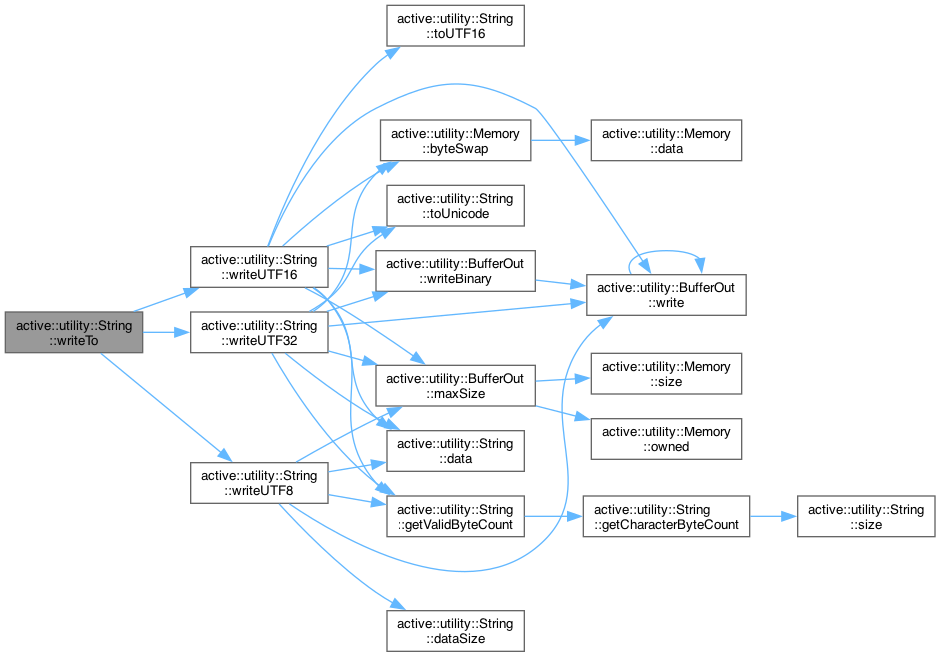
◆ writeTo()
| const BufferOut & String::writeTo | ( | const BufferOut & | buffer, |
| DataFormat | format = UTF8, | ||
| bool | isNullAdded = true, | ||
| sizeOption | howMany = std::nullopt, | ||
| sizeOption | maxLen = std::nullopt ) const |
Write this string to a buffer
- Parameters
-
buffer The destination buffer format The required output format isNullAdded True to add a terminating null howMany The number of characters to write (nullopt for all) maxLen The maximum number of chars to write
- Returns
- A reference to the destination

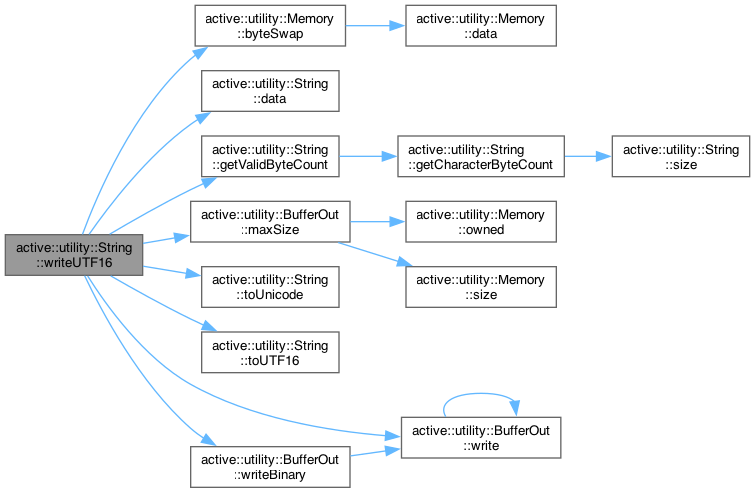
◆ writeUTF16()
| const BufferOut & String::writeUTF16 | ( | const BufferOut & | buffer, |
| bool | isNullAdded = true, | ||
| bool | isBigEndian = DataFormat::defaultEndian, | ||
| sizeOption | howMany = std::nullopt, | ||
| sizeOption | maxLen = std::nullopt ) const |
Write this string as UTF-16 to a buffer
- Parameters
-
buffer The destination buffer isNullAdded True to add a terminating null isBigEndian True if byte ordering is big-endian howMany The number of characters to write (nullopt for all) maxLen The maximum number of chars the destination can hold (including terminating null - nullopt for full length)
- Returns
- A reference to the destination

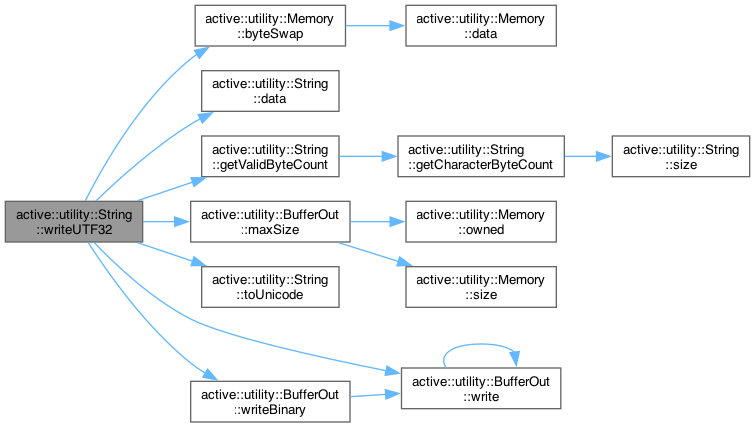
◆ writeUTF32()
| const BufferOut & String::writeUTF32 | ( | const BufferOut & | buffer, |
| bool | isNullAdded = true, | ||
| bool | isBigEndian = DataFormat::defaultEndian, | ||
| sizeOption | howMany = std::nullopt, | ||
| sizeOption | maxLen = std::nullopt ) const |
Write this string as UTF-32 to a buffer
- Parameters
-
buffer The destination buffer isNullAdded True to add a terminating null isBigEndian True if byte ordering is big-endian howMany The number of characters to write (nullopt for all) maxLen The maximum number of chars the destination can hold (including terminating null - nullopt for full length)
- Returns
- A reference to the destination

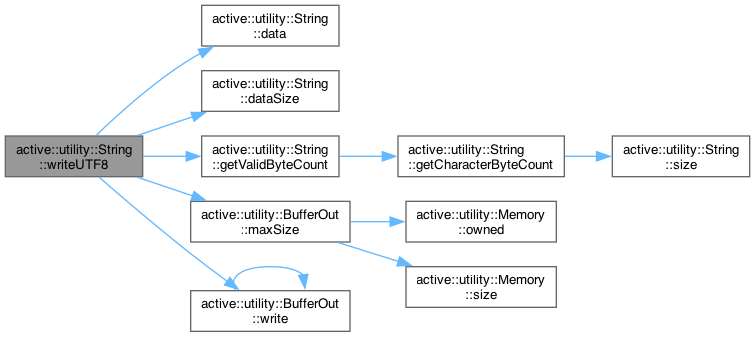
◆ writeUTF8()
| const BufferOut & String::writeUTF8 | ( | const BufferOut & | buffer, |
| bool | isNullAdded = true, | ||
| sizeOption | howMany = std::nullopt, | ||
| sizeOption | maxLen = std::nullopt ) const |
Write this string to a buffer (as internally encoded)
- Parameters
-
buffer The destination buffer isNullAdded True to add a terminating null howMany The number of characters to write (nullopt for all) maxLen The maximum number of bytes the destination can hold (including terminating null - nullopt for full length)
- Returns
- A reference to the destination

Member Data Documentation
◆ allFloat
|
static |
All floating point characters (floating and integer)
All numeric characters (floating and integer)
◆ allNumeric
|
static |
All numeric characters (integer and signed)
All numeric characters (floating and integer)
The documentation for this class was generated from the following files:
- /Users/rwessel/Documents/Development/ActiveLib/Active/Utility/String.h
- /Users/rwessel/Documents/Development/ActiveLib/Active/Utility/String.cpp