#include <MultiMap.h>
Public Member Functions | |
| MultiMap () | |
| MultiMap (const MultiMap &source) | |
| MultiMap (MultiMap &&source) | |
| virtual | ~MultiMap ()=default |
| auto | operator= (const MultiMap &source) |
| auto | operator= (MultiMap &&source) |
| auto | find (const Key &key) const |
| auto | insert (const raw_type &item) |
| auto | insert (const value_type &item) |
| auto | insert (value_type &&item) |
| auto | insert (node_type &&node) |
| auto | emplace (const Key &key, mapped_type &&item) |
| auto | emplace (const Key &key, T &&item) |
| auto | release (iterator &pos) |
| auto | release (const_iterator pos) |
Detailed Description
requires utility::Clonable<T>
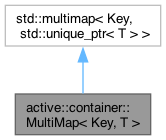
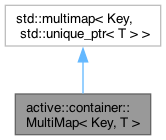
class active::container::MultiMap< Key, T >
A specialisation class for a multi-multimap of objects wrapped in unique_ptr paired with a key
This allows multi-multimap to store objects with polymorphic behaviour and object copying (object type must conform to Clonable). Keep in mind that the normal behaviour of the multi-multimap is to take ownership of any objects stored in it (unless release is used)
NB: There is no requirement for container items to be non-null. It is entirely up the implementor if this rule should be adopted or enforced
Constructor & Destructor Documentation
◆ MultiMap() [1/3]
|
inline |
Constructor
◆ MultiMap() [2/3]
|
inline |
Copy constructor
- Parameters
-
source The object to copy
◆ MultiMap() [3/3]
|
inline |
Move constructor
- Parameters
-
source The object to move
◆ ~MultiMap()
|
virtualdefault |
Destructor
Member Function Documentation
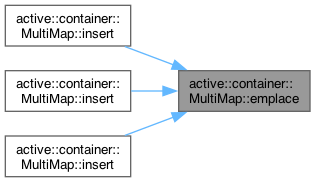
◆ emplace() [1/2]
|
inline |
Emplace a key/value pair into the map
- Parameters
-
item The key/value pair to insert (already wrapped in unique_ptr)
◆ emplace() [2/2]
|
inline |
Emplace a key/value pair into the map
- Parameters
-
item The item to push
◆ find()
|
inline |
Find a value with a specified key
- Returns
- An iterator pointing to the key/value pair (end() on failure)
◆ insert() [1/4]
|
inline |
Insert a key/raw value pair into the map
- Parameters
-
item The item to push
- Returns
- A map iterator pointing to the matching/inserted item paired with a bool (true if a new item was inserted)

◆ insert() [2/4]
|
inline |
Insert a key/value pair into the map
- Parameters
-
item The item to push
- Returns
- A map iterator pointing to the matching/inserted item paired with a bool (true if a new item was inserted)

◆ insert() [3/4]
|
inline |
Insert a map node
- Parameters
-
node The node to insert
- Returns
- A map iterator pointing to the matching/inserted item paired with a bool (true if a new item was inserted)
◆ insert() [4/4]
|
inline |
Insert a key/object pair into the map
- Parameters
-
item The item to push
- Returns
- A map iterator pointing to the matching/inserted item paired with a bool (true if a new item was inserted)

◆ operator=() [1/2]
|
inline |
Assignment operator
- Parameters
-
source The object to copy
- Returns
- A reference to this
◆ operator=() [2/2]
|
inline |
Assignment operator
- Parameters
-
source The object to move
- Returns
- A reference to this
◆ release() [1/2]
|
inline |
Release the pointer held by the specified item and erase
- Parameters
-
pos An iterator pointing to the item to be removed
- Returns
- The released pointer from the map item
◆ release() [2/2]
|
inline |
Release the pointer held by the specified item and erase
- Parameters
-
pos An iterator pointing to the item to be removed
- Returns
- An iterator at the next value
The documentation for this class was generated from the following file:
- /Users/rwessel/Documents/Development/ActiveLib/Active/Container/MultiMap.h