#include <HashMap.h>
Public Member Functions | |
| HashMap () | |
| HashMap (const HashMap &source) | |
| HashMap (HashMap &&source) | |
| virtual | ~HashMap ()=default |
| auto | operator= (const HashMap &source) |
| auto | operator= (HashMap &&source) |
| mapped_type & | operator[] (const Key &key) |
| auto | find (const Key &key) const |
| auto | insert (const raw_type &item) |
| auto | insert (const value_type &item) |
| auto | insert (value_type &&item) |
| auto | insert (node_type &&node) |
| auto | emplace (const Key &key, mapped_type &&item) |
| auto | emplace (const Key &key, T &&item) |
| auto | release (iterator &pos) |
| auto | release (const_iterator pos) |
Detailed Description
requires utility::Clonable<T>
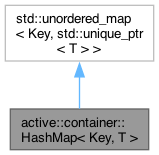
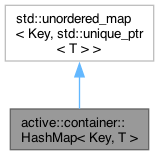
class active::container::HashMap< Key, T >
A specialisation class for an unordered map of objects wrapped in unique_ptr paired with a key
This allows map to store objects with polymorphic behaviour and object copying (object type must conform to Clonable). Keep in mind that the normal behaviour of the map is to take ownership of any objects stored in it (unless release is used)
NB: There is no requirement for container items to be non-null. It is entirely up the implementor if this rule should be adopted or enforced
Constructor & Destructor Documentation
◆ HashMap() [1/3]
|
inline |
Constructor
◆ HashMap() [2/3]
|
inline |
Copy constructor
- Parameters
-
source The object to copy
◆ HashMap() [3/3]
|
inline |
Move constructor
- Parameters
-
source The object to move
◆ ~HashMap()
|
virtualdefault |
Destructor
Member Function Documentation
◆ emplace() [1/2]
|
inline |
Emplace a key/value pair into the map
- Parameters
-
item The key/value pair to insert (already wrapped in unique_ptr)
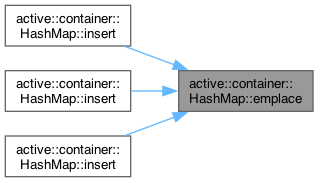
◆ emplace() [2/2]
|
inline |
Emplace a key/value pair into the map
- Parameters
-
item The item to push
◆ find()
|
inline |
Find a value with a specified key
- Returns
- An iterator pointing to the key/value pair (end() on failure)
◆ insert() [1/4]
|
inline |
Insert a key/raw value pair into the map
- Parameters
-
item The item to push
- Returns
- A map iterator pointing to the matching/inserted item paired with a bool (true if a new item was inserted)

◆ insert() [2/4]
|
inline |
Insert a key/value pair into the map
- Parameters
-
item The item to push
- Returns
- A map iterator pointing to the matching/inserted item paired with a bool (true if a new item was inserted)

◆ insert() [3/4]
|
inline |
Insert a map node
- Parameters
-
node The node to insert
- Returns
- A map iterator pointing to the matching/inserted item paired with a bool (true if a new item was inserted)
◆ insert() [4/4]
|
inline |
Insert a key/object pair into the map
- Parameters
-
item The item to push
- Returns
- A map iterator pointing to the matching/inserted item paired with a bool (true if a new item was inserted)

◆ operator=() [1/2]
|
inline |
Assignment operator
- Parameters
-
source The object to copy
- Returns
- A reference to this
◆ operator=() [2/2]
|
inline |
Assignment operator
- Parameters
-
source The object to move
- Returns
- A reference to this
◆ operator[]()
|
inline |
Subscript operator
- Parameters
-
key The subscript key
- Returns
- A reference to the value paired with the key
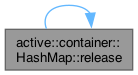
◆ release() [1/2]
|
inline |
Release the pointer held by the specified item and erase
- Parameters
-
pos An iterator pointing to the item to be removed
- Returns
- The released pointer from the map item
◆ release() [2/2]
|
inline |
Release the pointer held by the specified item and erase
- Parameters
-
pos An iterator pointing to the item to be removed
- Returns
- An iterator at the next value
The documentation for this class was generated from the following file:
- /Users/rwessel/Documents/Development/ActiveLib/Active/Container/HashMap.h